Thursday, 25 April 2013

Post-John Archer & Black Politics Presentation

Last week Tuesday’s John Archer & Black Politics presentation had one of the highest number of attendees for the history programmes at Battersea Library. I thank all who attended. Especially:

Sean Creighton, who contributed. Although Peter Fryer and several sources state that Archer’s mayoral vote was 40-39, Sean opts for the contemporaneous reports of the day, which indicate 30-29. Archer’s wife is often referred to as Bertha, an African Canadian, but Sean’s research shows his first wife was called Margaret, an African Canadian, whilst Bertha was the second wife, and English.

Knowing my stance in using ‘African’, and promoter of ‘black music’, Sean thought some clarification would be helpful. Well, there’s no confusion. Reproduced here from the TAOBQ (The Black Or African Question) blog is my position on the matter:

Black is a term that does not recognise the African identity or connection with the African continent. It was once a powerful and unifying political term, which embraced British “ethnic minorities” such as Africans and Asians. However, the latter have in recent years forged a separate identity, whether or not they were born in Asia, which has led to classifications such as Black And Asian, and Black, Asian And Minority Ethnic.

Whilst TAOBQ has no issues with ‘black’ in relation to an all-inclusive term for political solidarity among British ‘ethnic minorities’ or ‘black music’ describing a music genre, the campaign is advocating that people of African heritage be identified as African, instead of the meaningless ‘black’.

Next on the roll-call is Allswell Eno, who’s behind the The bLack Of Respect campaign, which aims to  “restore our dignity as a race by getting people, chiefly ourselves, as well as institutions in the UK, Europe and other parts of the world to cease referring to us as ‘black’ and describe us by heritage, like every other race.” Please support the bLack Of Respect petition for institutions such Office of National Statistics and others that engage in ethnic monitoring to abandon ‘black’ for African, be it British African, British African-Caribbean, African-American, African-Brazilian etc.

Brother Omowale’s attendance was a timely reminder for me to attend the PASCF (Pan-Afrikan Society Community Forum) workshop last Thursday on Kwame Nkrumah’s Consciencism philosophy. Although we only managed to read a few paragraphs on the introduction to ‘Consciencism: Philosophy and Ideology for De-Colonization’, I learnt so much about my former president because facilitator Brother Kwami made sure we understood the import of every sentence! Nkrumah did not use words “by heart” - each word was used purposefully.

If I was to sum up what I learnt - in a way Nkrumah is warning us about the mis-education of the then colonial African, who becomes learned through his engagement with Western philosophers and higher education, which if applied "wholesale" just props up the status quo i.e. Western capitalist and imperialist structures and viewpoints. It is the awakening or conscientisation which allows Africans to use that knowledge in a way that serves its people, rather than the colonisers.  

If you are interested in gaining a deeper understanding of the works of Nkrumah’s and other political thinkers, this free, small class is highly recommended. It’s not a seminar, and be ready to be a pro-active participant. Participants are encouraged to study particular topics in order to lead a discussion. The next Consciencism workshop is this Thursday April 25, 7-9pm at WASP (the West Indian Association of Service Personnel), 163 Clapham Manor Street, London SW4 6DB (Clapham Common). Just turn up or email: omowalerpt@yahoo.co.uk.

Nubian Jak almost gave the impression that my presentation was literally predestined, as that was the same day the news of the John Archer stamp was announced! I thought it was the Post Office that had introduced that horrible term ‘Afro-Caribbean’, but I was wrong – the Post Office’s website uses the African-Caribbean terminology. I suspect that ‘afro-‘ source must be the Daily Mail’s story, which has then been lazily regurgitated by other media!

Talking about black music, my organisation, BritishBlackMusic.com/Black Music Congress, is the initiator of British Black Music Month (BBMM), which takes place in June into mid-July - expect a Nubian Jak plaque to be unveiled in London  during BBMM2013. BBMM2013 will also feature a Vinyl Memories event in Battersea Library, and I’ll be roping in two old mates who attended, Clive Allick and Mark Jackson, as guests on the Veterans’ Front Room: Vinyl & Music Industry Memories sessions that will take place on the weekends in Wembley.

It seemed like everyone else had something to sell or plug, apart from me! Sean is the publisher of those useful booklets covering the likes of composer Samuel Coleridge-Taylor and Plymouth Labour activist Bill Miller. NARM role model Marc Wadsworth, who is mentioned in my presentation on account of being the biographer of John Archer’s one time comrade Shapurji Saklatvala, had copies of the ‘Divided By Race United In war And Peace’ booklet – you can see the trailer of the film at The-Latest.com.

Elder Clarence Thompson MBE, came very early and spent the time telling me and showing me material about things he had done, which he didn’t mention during my recent interview with him for the Look How Far We’ve Come project. He’s one of the unsung been there, done it type of fellow, whose history needs to be better known. He was given an opportunity to raise awareness and fundraise to help south London’s Queen Mother Moore move from a supplementary to a fulltime school, by selling a special badge and copies of his illustrated poem. The original is housed in the UN HQ.

Cllr. Tony Belton, who’s the councillor for John Archer’s old Latchmere, ward attended with Penny Corfield, who scripted the ‘Red Battersea: One Hundred Years of Labour 1908-2008’ DVD, which tells the story of Battersea’s long and chequered Labour party history. Naturally John Archer is featured. Penny was kind enough to give us a copy, and Cllr Belton sent me a copy of the John Archer portrait, which hangs in his hometown Liverpool. See the Battersea Labour website for details of how you can purchase a sleeveless version for £5.

Brother Omowale had flyers promoting his Pan-Afrikan People's Phone-In on Sundays 7-10pm (studio phone number 020 8144 4547). It can be heard via a link on the www.pascf.org.uk website.

To wrap up, it’s nice to see history teacher Dan Lyndon-Cohen kept the promise he made on the BASA e-list “to be more conscious in the future” by refraining from using “by people of Black and Asian heritage”. In his comment piece for History Workshop Online, ‘A Response to the Proposed National Curriculum in History’, he must be commended for using “people of African and Asian heritage”.

Nothing to do with history – well actually it does in a sort of round about way, and it focuses mainly on BASA interest areas, Africa and Asia, here are details of two Fairtrade related activities in Brent and Harrow: 

Fairtrade presentation 8th May 1-3:30pm
In the lead up to World Fairtrade Day, there will be a Fairtrade presentation by Cllr Nana Asante, Chairperson of Harrow Fairtrade Campaign and Brent Fairtrade steering group member, at the Luncheon Club, St. John's Community Centre, Crawford Avenue, Wembley HA0 2HX. The cost of the meal is £4 and the presentation will take place after lunch. For more information: catherineamiller@hotmail.co.uk.


Fairtrade Pop-up Restaurant
Mark World Fairtrade Day at the Fairtrade Pop Up Restaurant at Stanmore Baptist Church, Abercorn Road, Stanmore, HA7 2PH on Saturday 11th May 1:00-3:30pm. It’s organised by Harrow Fairtrade Campaign in partnership with Mission Dine Club (MDC) and is an opportunity to fundraise for MDC & Harrow’s Foodbank, and raise awareness about Fairtrade. The cost is £6.50, but £5.50 if tickets are bought at http://missionfair.eventbrite.com. Menu: Jollof rice & chicken and plantain, with vegetarian option, and dessert. For more information: missiondine@hotmail.co.uk.

Lastly, lastly, lastly – I had an opportunity to watch the South African made feature film ‘Otelo Burning’ last Sunday. Although Flash Musicals Film Club’s regular spot at the their Edgware base is the first Friday of the month, from 6.30pm (£5 adults, £2 children, includes meal), they do the occasional Sunday special. This screening had the director and one of the cast, whom we were able to chat with. Whilst the film is said to be based on real life incidents around the time the country was about to move towards multi-racial elections and surfing, there’s a disturbing end bit, which was not based on an actual incident. It was so bleak, one wondered why the director swung her artistic licence in that direction, instead of offering some positivity or hopeful alternative.

Kwaku


John Archer and Paul Stephenson are NARM role models and the focus of BTWSC/African Histories Revisited’s 2013 African British history presentations. it will be 100 years since John Archer became London's first African mayor, and 50 years since Paul Stephenson successfully led the Bristol Bus Boycott. For more information regarding creating or delivering an African British civil rights history programme around these 2 NARM role models: btwsc@hotmail.com. For event details and bookings: www.narm2013.eventbrite.com.

Friday, 18 January 2013

A Lot Of Noise About "Black History" But How Serious Are We Really About African History?

A Lot Of Noise About "Black History", But How Serious Are We Really About African British History?

By Kwaku
TAOBQ co-ordinator

Jan. 11 2013 Update:
Mary Seacole and Olaudah Equa
ino are included in the recently published draft National Curriculum (NC), but for those calling this a victory, please read history teacher Dan Lyndon's 'A Pyrrhic Victory' (also copied at bottom of this page), which points out the other African history elements that have been removed. Incidentally, four days after the Jan. 2 publication of OBV's 'Michael Gove dumps Mary Seacole', there were 43 comments. Within the same period since the triumphant piece 'We’ve won ! - Mary Seacole, Olaudah Equiano' was published, there's been only 3 comments. It makes me wonder if we really cared that much, except for the maintenance of the status quo i.e. have Seacole in the NC. As in my piece below, I think I'm right to say Gove really had people dancing on a pin - he's certainly played most of us!

Incidentally, the African experience is dealt with in the draft NC under: "The slave trade and the abolition of slavery, the role of Olaudah Equiano and free slaves". Hopefully you'd have noticed the oxymoronic expression "free slaves"!
 

It may be cold in January, but Education Secretary Michael Gove has got many people hot and bothered - Africans, non-Africans, historians, politicians, community leaders, unionists, left-wingers, multi-culturalists, feminists, race and diversity experts, and a number of other groupings that don't immediately spring to mind, are in a tizzle as he has them dancing on the head of a pin.

Why the fuss? Because a leaked document alleges that among the historic personalities being dropped from a Gove-ordered revision of the schools' history curriculum, are the only two African British personalities - the 19th century Jamaican-born nurse and entrepreneur Mary Seacole and the 18th century African born (in present day Nigeria) abolitionist and entrepreneur Olaudah Equiano. 

Not surprisingly, there were emails flying about regarding the matter, some pointing to the OBV (Operation Black Vote) led petition to oppose the removal of Seacole from the national curriculum.

My online search for the petition initially brought me to an OBV blog entitled 'Michael Gove Dumps Mary Seacole'. It was a piece that excellently made the case for Seacole's place in the curriculum. 

So even though I was later to sign the petition, I thought the issues were wider than Seacole or indeed Equiano, who I was the first to introduce into the discussions in my comments entitled Also Expunged Is Olaudah Equiano. Way Forward (also copied below). Thankfully whilst the petition is focused on Seacole, Equiano was added in an open letter by the petition organisers and their supporters. 

Then on the BASA (Black and Asian Studies Association)  e-ring for historians and teachers, I suggested instead of just focusing on the national curriculum, and who’s in or out, that the network could set up a complementary African history curriculum, which would provide a wider list and sources for anyone interested in African history. A meeting has been called to move this forward.

So TAOBQ has done its bit cutting through the noise and offering some useful suggestions. All that’s left to say is that how many of the people making noise, signing petitions and feverishly forwarding emails on the matter, really care about African history – be it what’s taught in the schools, or during Black History Month (BHM)?

Indeed, some people are not particularly interested. They just want things to be there. I'm reminded  of the time London Mayor Boris Johnson slashed the mayoralty's Black History Month budget. There was the expected hue and cry. Though I believe the majority of those making the noise had not even attended one of the Mayor's BHM events.

Over in Harrow, I know that the year the Council "forgot" to mark BHM, a number of individuals made enquiries and noise. However, when BHM was belatedly re-introduced, did these supposedly interested fans of BHM turn up? Nope.

If you’re interested in African history, then look beyond what’s on the national curriculum. Simply because it can not offer anything near passable or adequate coverage of our history. There are a whole range of resources and programmes that cover the breadth of our history. That’s something Gove can not control!


Throughout 2013, TAOBQ, BTWSC and African Histories Revisted will be delivering a number of African British history programmes highlighting NARM role models John Archer and Paul Stephenson. It will be 100 years since Archer became London's first mayor, and 50 years since Stephenson successfully led the Bristol Bus Boycott. For more information regarding creating or delivering an African British civil rights history programme around these 2 NARM role models: email: btwsc@hotmail.com.

Also Expunged Is Olaudah Equiano. Way Forward
Submitted by Kwaku (not verified) on Thu, 03/01/2013 - 21:59.

I came by this excellent article because I heard OBV has a campaign to pressure Education Minister Michael Gove from going ahead with his plans to remove Mary Seacole from the new History curriculum.

Whilst I am not against such a campaign, I would like to highlight the fact that the African abolitionist Olaudah Equiano has also been moved out, or should I say, expunged, from the new curriculum. So my question is that would a joint petition for the two African British historic personalities be better than two separate petitions?

As it is, we are responding to a leaked draft, so there may a small window for the likes of Seacole and Equiano to be "re-instated" in the new history curriculum.

Abolition of chattel enslavement and immigration are said to be left in the new curriculum - not sure what's happened to American civil rights. The old curriculum allows for topics such as resistance against enslavement, but how many teachers would know, let alone teach about about Nzinga, Sharpe, Bussa, Kofi, L’Ouverture, Nana (Nanny) etc?

Immigration, for example, should not just be about "new" or "different" peoples coming to Britain, or the change of the cultural landscape. What about the impact on the social and political landscape, as a consequence of activism which brought in race relations laws, which begat the other equality laws.

The way forward? I don't think the school history curriculum can satisfy everyone. So I've suggested to BASA (Black And Asian Studies Association) historians and history teachers that politicians will always play yo-yo with the history curriculum, and that the way forward ought to include producing a complementary curriculum which those who are interested in African British history can refer to.

If people are interested in African British history, then as much as they should fight for maintaining or re-instating Seacole and Equiano, they should also look at the complementary curriculum from which they can improve theirs and their children's knowledge of African history whether through self-study, Saturday schools, community projects, or other informal learning routes.

Some of us are not waiting on the schools to do it all for us. I run African history projects through TAOBQ (The African Or Black Questions), Akoben Awards and BTWSC. Other community organisations doing the same include the likes of Black History Walks, Nu Beyond, Ligali, etc.


A Pyrrhic victory

Although the inclusion of Seacole and Equiano is welcomed, the new NC proposals are a disgrace. They represent the complete reversal of all the progress that has been made over the last decade in ensuring Britain's diverse history is recognised and taught in schools. The tokenistic reference to Seacole and Equiano ignores the significant contributions that have been made to this country by people of Black and Asian heritage and wipes out a presence that has been recorded since Roman times. The first time any student will even know of this presence, under the new proposals, will be after studying history for 7 years! and the first thing they will be taught is that Black people were slaves. Gone is the awareness of African civilizations, the Blackmoors in Tudor Britain, radicals such as Cuffay, Davidson and Wedderburn. Where will students learn of the writings of Ignatius Sancho, the performances of Ira Aldridge or Samuel Coleridge Taylor? How can they be inspired by the pioneering efforts of Walter Tull or Claudia Jones? This misguided, amateurish attempt to impose a narrow, Little Englander interpretation of history must be challenged with the same vigour and passion as the campaign to support Seacole.

Friday, 28 December 2012

Do We Still Need Kwanzaa? Definitely Yes!

Do We Still Need Kwanzaa? Definitely Yes!

by Kwaku
www.TAOBQ.blogspot.co.uk


Was it a case of serendipity that on the day I received email of another African American history professor’s brush with the police, and started my as yet unfinished email to the founder of Kwanzaa, Dr Maulana Karenga, I should chance on a HuffPost article on Kwanzaa, that I just had to respond to?

The article in question is a recent HuffPost Black Voices co-ed by former White House fellow Theodore Johnson entitled 'Do WeStill Need Kwanzaa?' Although I don't celebrate Kwanzaa, neither do I celebrate Christmas, birthdays etc.

As much as Johnson tries to be balanced, I do not agree with his main argument. Which is that African Americans have now achieved in a post-Civil Rights era - they've made it into the middle classes, they occupy positions of leadership in the public and corporate spheres, and even occupy the White House, and that they ought to see themselves more as American, and less as African. Hence Kwanzaa is a celebration where its sell-by date is almost up, if it hasn’t already expired.

It would seem segregation and discrimination have been kicked to the curb, and African Americans are now getting their just share of the proverbial American Pie. Is that the reality for the majority of African-Americans?

For those who think they've safely broken through the glass ceiling, and even with an African as the President, here is a warning or reminder: never mind the streets and ghettos, where the opportunities and civil rights of Africans who have not been able to pull themselves up the ladder are routinely trampled upon and who are herded into the criminal justice system as fodder. But what about the number of times we hear of educated, middle-class African Americans reminded of their “supposed place"?

What did one former American president, often described affectionately as a "black" President say about the then presidential hopeful Barack Obama? Something on the lines of a little while back, he would have been serving tea to Europeans, and now he has the temerity to run for president.

And Henry Louis Gates is not the only professor to wonder if the treatment he got from the police was simply because he was African, in spite of how far he'd come up the social and educational ladder. Earlier this year, a less celebrated professor of history and Africana studies Jahi Issa, author of ‘The Ethnic Cleansing of Historically Black Colleges in the Age of Obama’, had a brush with the Delaware State University (DSU) police, which not only landed him in hospital with severe injuries, but he is also facing prosecution on charges including resisting arrest, offensive touching of a law enforcement officer, and inciting a riot at DSU, which could put him in prison for several years.

That's enough reason why, African Americans who choose to celebrate Kwanzaa ought to do so, in the solid belief that the raison d'être for Dr Karenga introducing it during the heady days of the 1960s Civil Rights struggles has not changed one iota. It’s nowhere near its sell-by date.

Just because some Africans have made it into high places – be they police or military officers, judges, mayors, senators, university professors, public company CEOs – good on them,  but don’t be fooled into believing it's a post-Civil rights, post-racial American society, and that it’s time to put away your African celebrations, like Kwanzaa. Hey, for those celebrating it, I’m moved to shout out: “Happy Kwanzaa”! 
 

Kwaku is the TAOBQ (The African Or Black Question) campaign co-ordinator. http://www.TAOBQ.blogspot.co.uk.

Highlighting Brazil's Complex African Identity And Race Issues

Highlighting Brazil's Complex African Identity And Race Issues

Kwaku
TAOBQ co-ordinator


December 28 2013

We've all heard about Brazil having one of the largest African populations outside of the African continent. We've all heard Bahia has one of the strongest, rootsy African cultures in the Americas, and when we hear a samba tune, we immediately associate it with Brazilian culture. Of course everyone knows that Brazil is one of the world's top football nations.


Well, I even have some Brazilian roots from the Tabom people - African-Brazilians who returned to Ghana and other West African territories. But apart from some of its music, I haven't been particularly interested in Brazil, and was not aware of its complex African identity and race issues until very recently.


Oh, that's apart from a story I heard at a Soul Trade seminar many moons ago - I think it may have been told by Dotun Adebayo in his days as a music journalist. Apparently, despite the huge number of Africans within Brazil society, its people were just not used to seeing successful Africans within the mainstream (perhaps with the exception of Pele) that when they saw crossover music stars on TV like Michael Jackson and Tina Turner, they just assumed that they were European!


In Britain, when "black" is used as a racial descriptor, it generally means people of African or South Asian heritage. In the political context, it can be as broad as to cover non-Europeans, and can even go as far as covering oppressed European groups! In the US, "black" pretty much covers people of African heritage, irrespective of whether their antecedents are located in Africa, or more recently, from the Caribbean.


However, in Brazil, it turns out to be another ball game! It seems our debate about what we call ourselves in Britain is nothing compared to what's going on in Brazil - The Black Women Of Brazil blog has an article on the subject worth reading: Black (Negro) or African descendant (Afrodescendente)? What's in a term?


The article explains the five main racial classifications (for a fuller understanding of terms such as "preto" (black), "branco" (white), "pardo" (Mixed-race, brown), "amarelo" (yellow, East Asian) and "indígena"/''indio" (Amerindian) see Racial Classification And Terminology In Brazil  or Afro-Brazilian), the recent revelations from the 2010 Brazilian census, and which terminology three well-known Brazilians of African heritage prefer to describe themselves by.


Interestingly, whilst Brazil is held up to be the nation with the most Africans outside of Africa, strictly speaking, only 7.6% of the 2010 census identify themselves as "black", "preto" or African. That's about 13 million out of a population of some 195 million people of different shades.


This is the 2010 census breakdown: "Brancos" ( 47.3%),  "Pardos" (43.1),  "Pretos" (7.6%), "Amarelos" (2.1%) and "Indígenas" (0.3%). However the figures do not tell a complete story - the census is dependent upon self-identification by respondents, so perception and reality are not always the same. For example a "pardo" who sees himself as "branco", can self-identify as such on the census and hence pass as white.


However, advocates of the Movimento Negro (African Brazilian movement), which urges African pride, also argues that the African-Brazilian population is politically, culturally and racially made up of those classified as "preto" (African) and "pardo" (part-African), which makes up what is popularly described as the "Afro-Brazilian" population. "Pardo" covers those described as "mixed race", and also known as brown, mulatto, or "mestizo". Among the "pardo" is a mixture of African with European, Asian, and/or Amerindian. The numerous permutations produce a wide range of shades and phenotypes.


Whilst some "pardos" are comfortable aligning themselves with the "Afro-Brazilian" terminology, others, one would imagine those closer to "brancos" in shade and other typical European phenotypes, whilst not passing themselves as "brancos" do not want to be identified by their African blood.


Other terms worth noting are "morena", which basically describes a brown or light skinned female of African heritage, whilst "negra" basically refers to a female with mainly African features. Considering the socio-economic advantages of being a "morena", ironically the actress Camila Pitanga, who is an obvious "morena" takes pride in describing herself as a "negra", whilst the media  often describes her as a "morena" and asks her why she insists on describing herself as a "negra"!


With the 2010 census showing that the African-Brazilians are the biggest racial group for the first time in the country's history - the "preto" and "pardos" population has grown whilst the "brancho" population has fallen in the last 10 years - perhaps it's not surprising that another terminology has sprung up to describe this ethnic majority group: Afrodescendente, which means African descendant.


It's a good move, in that it links people to their African ancestry. But what's up with the Brazilian love for the word "Afro", which in places like Britain is often associated with the Afro comb! And as all humanity descended from Africa, they ought to consider using African heritage instead (see Thinking About Language In Teaching African History - the TAOBQ Primer).


Glória Maria, a famous TV host/journalist doesn't like Afrodescendente, favouring negro ("black") or "neguinha" (supposedly a term of endearment meaning "little black woman"). Is it because Afrodescente identifies too strongly with Africa? Particularly for someone in mainstream media, where a strident African association may not be perceived as a career enhancer. Incidentally, we've been there before - the TAOBQ campaign started by finding out which terminology African heritage people in London preferred - African or black? 


Preta Gil is a singer and actress, and the "prado" daughter of Gilberto Gil, a famous musician and former Brazilian Minister of Culture in Brazil. With her first name mistakenly substituted with "Preto" and even "Afrodescente", no wonder even though she recognises her African roots, she dislikes labels of any kind.


It's left to  singer Toni Garrido to give the unequivocal support for the use of "Afrodescente". Says Toni: “I use Afrodescendente because it’s a cooler word than negão, crioulo or neguinho."


Curiously, there isn't much of a socio-economic gap between the "preto" and "pardo". However, not surprisingly, there's a massive gap between the African-Brazilian and their European counterparts.


To deal with racism in Brazil, I'm indebted to an article on Travel Making Kai's blog entitled 'A Lighter Shade Of Black… Observations Of Racial Identity In Rio'. I'd like to think that she's taught me a bit about our Tabom history, and that through attending some of the TAOBQ events, I've made her more aware of issues around African identity.


Kai, who's on a visit to Brazil, where she's researching Tabom history, is also taking the opportunity to research the experiences of continental Africans living in different parts of Brazil. 


'A Lighter Shade Of Black…' reveals the racism and sexism African women face in Brazil. Kai sees beyond the "We’re all one people - Brazilian" facade. She even talks about an Irish mother who faces discrimination because she has a "pardo" child,  and some of the discrimination associated with what's popularly known as "shadism".


Well, this just about scratches the surface of a deep issue. Should you wish to explore further, I've copied below some links to use as a starting point on your journey of discovery of Brazil's rainbow nation.


Another important area, sadly not touched on here, is class, and how it places out in tandem with racism.


Sources:

Kai Li's Tabom Project
http://www.facebook.com/pages/Kai-Lis-TABOM-project/266125266965

A lighter Shade Of Black… Observations Of Racial Identity In Rio

http://travelmakerkai.wordpress.com/2012/12/21/a-lighter-shade-of-black-observations-of-racial-identity-in-rio

Black (negro) or African descendant (afrodescendente)? What's in a term?

http://www.blackwomenofbrazil.com/2012/11/black-negro-or-african-descendant.html

Racial classification and terminology in Brazil

http://www.blackwomenofbrazil.com/2011/11/racial-clasification-and-terminology-in.html

Brazil census shows African-Brazilians in the majority for the first time

http://m.guardian.co.uk/world/2011/nov/17/brazil-census-african-brazilians-majority

Saturday, 24 November 2012

Black History Month May Be Over For Another Year, But We Rewind To Some BHM Issues

Black History Month May Be Over For Another Year, But We Rewind To Some BHM Issues

Kwaku
TAOBQ co-ordinator

November 24 2012

This piece is from a comment to an article entitled 'Why Black History Month Is Damaging To Black Culture' by Chama Kapumpa, published by Sabotage Times.


Dear Charma,

I applaud you for writing this article, and I admire your desire for discourse on BHM, particularly as you're studying history within an academic environment which encourages discussion. Your wanting to have a focus on African British history is one I concur with.

As much as I am about global African history - by the way, I'm writing this from Accra, Ghana where I facilitated a workshop last week entitled 'What Does It Mean To Be A Global African?' Positive feedback's led to a followup workshop, ‘How To Regain Our African Identity And Self-Confidence’ on Oct.24 – however, I believe efforts must be made to tell African British histories – it does require some effort, unlike the more prevalent African American histories, particularly the Civil Rights movement, which is a history curriculum topic.

What do we know about our own African led civil rights movements in Britain? Next year, the focus will be on the 50th anniversary of Martin Luther King’s ‘I Have A Dream’ speech – but how many of us know that the day that speech was made also marks an historic moment in British history? That and a few other not so well known incidents were some of the histories I presented last year in a series of NARM African British Civil Rights Histories presentations across London.

Anyway, back to your article – I think some of the points you raise are not failings of the Black History Month (BHM) concept, but rather a deficiency in the programmes that are delivered under the BHM banner. Firstly, the fact that BHM is wide ought to be an asset. 

The deficiency lies in the laziness of schools, councils, unions, and community organisation who deliver BHM events, in that they often pluck for the narrow, same-old, same old topics – enslavement, Mary Seacole, Rosa Parks, Martin Luther King, Nelson Mandela, and lately, Obama. And those are the ones that are supposed to have a history focus.

The wideness of BHM allows us to connect in many beautiful ways, if only we can see the dots. For example, we’ll be showing ‘The First Grader’, but as heart-warming as it is in the main, it offers us an opportunity for a little discussion on the value of education within the African British communities, and to look at the dark side of British history from the context of what happened during British colonial rule in Kenya.

My view is that most of what passes as BHM tend to entertainment and cultural programmes, which I believe can be put on any other time of the year. It seems you’ve been lucky to have had quizzes, where some effort have been made to focus on history, even if the focus is seldom on African British history. That said, Charma, there are some creditable, accessible and engaging BHM programmes delivered using a range of techniques, from talks, Powerpoint presentations, films, to edu-tainment performances which focus on history, particularly those relating to Britain. African history is part of world history, and some are part of British history. But as you pointed out, history is selective.

If you think BHM gives African history an “otherness” – please note that not all histories can be mainstream. For example, are the histories of the Londoners who’ve lived in the east of London for centuries not worthy of being mainstream? But can’t their histories be just as easily described as the “other” in terms of mainstream British history? I have no issue with African history seen as the “other”, so long as when it’s delivered, be it under BHM or in history class, it’s presented by knowledgeable people and devoid of Eurocentric biases, which many of us unwittingly regurgitate! You also made the point that there is seldom the opportunity to engage in discussion.

As I’ve said, that’s not the fault of BHM, but the programme designers or organisers. Having said that, there’s a world of difference between what one expects to achieve in a 3 hour BHM event, and a 3 year undergraduate history course. On your course, as future historians, you are being taught to question, and time has been factored in to learn and appreciate that skill. The majority of those attending BHM events are not historians. They attend either to be entertained or to learn a bit more African history. I’d suggest the priority ought to be creating an accessible non-academic environment to learn some African history, rather than whether or not they can critique the information delivered. Critiquing is part of an academic discipline. BHM events ought to be a learning, but not necessarily an academic exercise.

That said, I’ve been delivering BHM events – soon to be simply called AHM (African History Month), which do not only provide information on some aspects of our wide history (or histories), but also allow some form of discussion. That’s simply because the knowledge base does not reside solely with facilitators and panellists, even if they’ve got a number of history degrees. I’ll throw a challenge for you to experience 25 Years On… on Oct. 30 @ Harrow Civic Centre. It’s the only BHM event marking the 25th anniversary of the introduction of Black History Month in Britain and the Labour Party’s Black Section’s success with the election of the 4 African and Asian MPs in 1987, and which brings in the behind the scenes stories of those that were there doing the works. Click for 25 Years On... event report.

Finally, I’ll like to point to the title of your article, which may not have been written by you – ‘Why Black History Month Is Damaging To Black Culture’. BHM is about history, but because of the prevalence of what passes for BHM, BHM is seen to be more about culture, rather than history of African people. I’m not sure how BHM is damaging “black” culture – whatever that means, when in the main, the only culture we see is singing and dancing. For example when was the last time you saw a BHM programme focused on the role of the griot or kora in west African societies, or the role of the pardner or susu culture within African Caribbean communities in Britain?

Wednesday, 7 November 2012

Harrow event reaffirms Black History Month African-centred focus and Black Sections members highlight their efforts in the election of the 4 “black” MPs in 1987

Harrow event reaffirms Black History Month African-centred focus and Black Sections members highlight their efforts in the election of the 4 “black” MPs in 1987

Nov. 7 2012


A meeting last week in the Council Chamber in Harrow, north London heard from those directly linked to two milestones in African British history, which took place in 1987.

25 Years On… focused on how Black History Month (BHM) was introduced by Greater London Council successor organisations, such as the London Strategic Policy Unit (LSPU) a quarter of a century ago, and also on the work of Labour Party’s Black Sections group, which led to the selection and election of the first African MPs – Bernie Grant, Diane Abbott and Paul Boateng (Keith Vaz, was not the first Asian MP – that honour goes to Dadabhai Naoroji, elected as a Liberal MP in 1895).

The free event, organised by WHEAT Mentor Support Trust and Akoben Awards, attracted a diverse audience including councillors, community activists, teachers and young people.

The panel and special guests were made up of activists in local government and politics in the 1980s. This included Ansel Wong, former head of LSPU’s Race Equality Policy Group (REPG), Addai Sebo, REPG policy team leader, Marc Wadsworth, former chair of Black Sections, Bernard Wiltshire, former deputy leader of the Inner London Education Authority (ILEA); and Narendra Makanji, a former Black Sections chair and Haringey councillor, who along with Linda Bellos, another Black Sections member and former LSPU chair and Lambeth Council leader, got London councils to declare the period from August 1987 to July 1988 the African Jubilee Year and mark October as BHM in Britain.


The introduction of BHM, which was predicated upon the tenets of the African Jubilee Declaration, was a way of redressing the pernicious effects of racism upon African people, and to counter the misinformation and lack of knowledge of the African contribution to world civilisation.

“The essence of the Declaration was that the London boroughs and authorities would make just restitution … just restitution means reparations, to years of incalculable damage done to the African,” explained Sebo, who conceived the idea for BHM in Britain after hearing a colleague tell him about the racial identity issues facing her young African son named after pan-African champion Marcus Garvey.

Concurring with Sebo, Wong added that although “the essence of what we were trying to do was to bring about a recognition that people of African descent have made significant contributions to the development and success of British society and to the world,” the use of the  word “black” was a pragmatic “political convenience”  to pass the commemoration through Labour and Conservative councillors in the London boroughs that supported the Declaration.

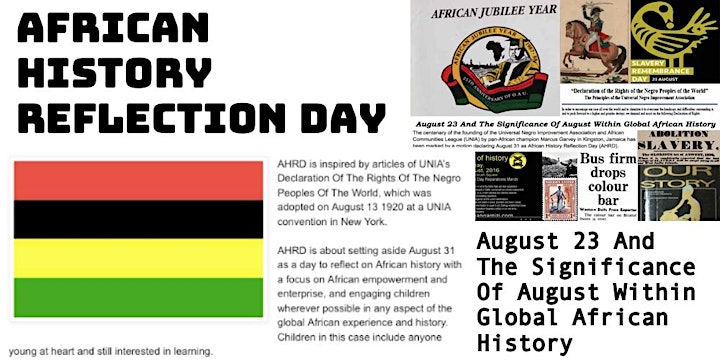
The African Jubilee Declaration  was presented as part of African Jubilee Year (August 1987 to July 1988) by the London Strategic Policy Committee,  the Association of London Authorities and the Inner London Education Authority in recognition of three global African history landmarks: the centenary of pan-African champion Marcus Garvey's birth, the 150th anniversary of the emancipation of  formerly enslaved Africans in the  Caribbean, and the 25th anniversary of the founding of the Organisation of African Unity (OAU).

Among the commitments the Declaration enjoined the bodies that signed up to it included the promotion of “positive public images and an understanding of Africans and people of African descent and encourage the positive teaching and development of their history, culture and struggles”.

However event chair, co-ordinator of Akoben Awards and TAOBQ (The African Or Black Question) Kwaku pointed out that the political landscape has now changed. “As of today, as we’ve commemorated the twenty-fifth anniversary of Black History Month, from now on, it’s African History Month,” declared Kwaku.

“They were in a different political situation, where they had to make compromises to talk about Black History Month. And also there was then  the political black – that’s why Narendra could stand together with Marc – Asian heritage and African heritage. But things have changed, Narendra is now often described as Asian, rather than black.”

African History Month, will continue to be a forum for all members of the community to engage in and learn from. However as Harrow deputy mayor Cllr Nana Asante pointed out: “It’s like a bus – Africans are the drivers, and everybody else is a passenger. It’s all encompassing. Everybody is welcome. But the history we talk about is African history.”

The event ended with Wadsworth speaking about how, in spite of lack of support from the Neil Kinnock/Roy Hattersley Labour Party leadership at the time and some serious opposition from within the party, the Black Sections was able to force through changes. This included overcoming opposition to the formation of a group to address race issues within the party that removed two African females who Black Sections had helped to be selected as parliamentary candidates.

Whilst the Black Sections may be best  remembered for helping bring about the victory of the 4 “black” MPs of 1987, Wadsworth reminded the audience that its work also resulted in getting hundreds of councillors elected across Britain. His parting words for the new crop of activists were “organise, organise, organise.”


ENDS


Notes

• BHM was officially inaugurated in the UK on October 1 1987 with a series of programmes aimed at school children and  adults at the (by then abolished) Greater London Council's old building, County Hall, where Dr Maulana Karenga gave the opening keynote address. Other African historians who made presentations during the African Jubilee Year included Dr Yosef ben-Jochann, Dr John Henrik Clarke, Dr Tony Martin and Dr Frances Cress Welsing. Their presentations are compiled in the currently out of print book, ‘Our Story: A Handbook of African History and Contemporary Issues’ (Addai-Sebo, Akyaaba and Wong, Ansel, eds 1988, London Strategic Policy Unit, 1988).

· • The official BHM logo incorporated the Sankofa symbol. Its significance is underscored by Dr John Henrik Clarke, who delivered this Sankofaism: “If we have to change tomorrow, we are going to have to look back in order to look forward."  
  Addai Sebo now lives in his birth place, Ghana, from where his contributions were made via video
• 'Recollecting African British History: My Role In The Launch Of Black History Month' by the then ILEA deputy leader Bernard Wiltshire, one of the supporters of BHM, and who delivered a speech at the BHM launch, is posted at: http://taobq.blogspot.co.uk/2012/11/recollecting-african-british-history-my.html
Photos by Linda Panford, except * by Kwaku. Hi res upon request
Subjects include:
Ansel Wong, former head of LSPU’s Race Equality Policy Group (REPG)
Addai Sebo, REPG policy team leader*
Marc Wadsworth, former chair of Black Sections
Dr Hailu Hagos, executive director of WHEAT MST
Kwaku, co-ordinator of Akoben Awards and TAOBQ (The African Or Black Question)
Bernard Wiltshire, former deputy leader of the Inner London Education Authority (ILEA)
Narendra Makanji, former Black Sections chair and Haringey councillor
Jessica & Eric Huntley, community activists and publishers
Mia Morris, political aide and founder of black-history-month.co.uk

Recollecting African British History: My Role In The Launch Of Black History Month

Recollecting African British History: My Role In The Launch Of Black History Month
By Bernard Wiltshire
Then ILEA deputy leader 

From 1986 to 1988, I was the deputy leader of the Inner London Education Authority (ILEA), the institution that was responsible for education in the Inner London Boroughs. Those who were around at the time will remember the determination of the Thatcher Administration to abolish the Greater London Council (GLC) of which the ILEA was its Education Committee.
It soon became clear however that it was impractical to abolish the GLC in its entirety all at once. The provision of education services to the Inner London Boroughs was too complex to be dealt with that way, so it was decided to set up the ILEA as a free standing, independent authority in its own right while a scheme for devolving education to the individual boroughs was worked out.

Elections to the new Authority took place on constituency basis in 1986 and I was selected by the Hackney and stoke Newington constituency to represent the Labour Party, along with my running mate Stephen Benn.

I came to the ILEA with an agenda which had a lineage of almost two decades in the making, and that was to put a stop to the systemic underestimation of and expectation for black children in the school system. The problem had been identified as far back as the closing years of the decade of the 60s in a small research paper written by Bernard Coard at the behest of Caribbean activists, mainly consisting of artists, writers and poets, who had gathered themselves under an organization called the Caribbean Education and Community Workers Association (CECWA).

The group first met at the West Indian Student Centre and later at the bookstore of John La Rose in North London to consider Coard's report, entitled ‘How the West Indian Child is made Educationally Subnormal in the English School System’. The disclosed findings made a tremendous impact on me, having just graduated at the time from the University of York with all the brashness and impatience that youth can usually muster.

One of the solutions considered by CECWA was the establishment of Supplementary Schools, run by the black community to counter the harmful effects of racism on our children, concentrating on black history and conscientisation, aimed at raising self-esteem as well as knowledge of black heritage, stemming from Africa, and to supplement the teaching of the "3Rs" to our kids.

Armed with this resolve, I immediately proceeded to set up the Kwame Nkrumah Supplementary School in Hackney in 1971, one of the first of its kind in the country. Of-course, progress in tackling the problem was extremely slow. We could only tinker at the edges as this was a new idea at the time. We had to depend entirely on volunteers in the black community and resources were very scarce. Nevertheless, the seeds of a new idea had been planted and I would like to pause to pay tribute to the dedicated black men and women, the Jessica Huntleys, Reds, Elva Didiers, Gwens (cannot now recall full names) and the others who gave much without ever counting the cost.

A further development at tackling the same problem was made in the 1980s with the establishment of the Black School Governors' Collective with black activists such as Steve Delsol and others,  which aimed at giving black parents a stronger voice in the government of schools in order to better protect the black child in the throes of the system. It was to further those aims that I subsequently ran for a seat on the newly set up ILEA in 1986 and was elected its Deputy Leader under the leadership of the talented and astute late Frances Morrell.

It was in my capacity as Deputy Leader of ILEA that two young black activists, Addai Sebo and Ansel Wong, based I believe in Lambeth Council, asked to see me to solicit my support for the establishment of a Black History Month in the UK, similar to a comparable initiative in the United States. It was an initiative with which I was well familiar having participated in the establishment of the Black Studies Programmes the US in the early 70s.

I knew that what Addai and Ansel wanted to do could not be done without the backing of a powerful institution such as the ILEA. No doubt, they realized this also, and as Deputy Leader of the largest and most powerful education institution in the country, I was in a position to make it happen, as happen it did. The problem was that while the Labour ILEA was undoubtedly a progressive educational institution, there were different views within it of how to deal with black cultural self-awareness. The old dichotomy between integration and the promotion of separate cultural expression threatened to pose itself as an obstacle. The idea was even considered "dangerous and divisive" in some quarters of the Authority. Nevertheless, I was resolved to persevere, believing as I did that the two concepts coexisted in a dialectical necessity and that their separation could only amount to a false dichotomy.

Perseverance and a strong argument paid off. Following a number of planning meetings with Addai and Ansel, I was able to obtain the almost unanimous support of the members of the ILEA, especially of its leader, the late Frances Morrell. The day of the inauguration was certainly a memorable occasion. It was held in ILEA’s old oak paneled Council Chamber at County Hall. Our guest speaker was a professor of history from the United States, whom Addai and Ansel had invited, but I gave the opening introductory address, which apparently had such an impact on one participant that he later confessed to me that he had to hold on to the edge of his chair during my address to overcome the sensation of falling!

I confess that it was a disappointment to me when subsequently a report of that seminal occasion appeared without my address. Later I left the UK and returned to continue our struggle for the upliftment of our people in Dominica and the Caribbean; and I suppose in my case, it was a question of out of sight out of mind. But I would like my role  to be recognised since without my input at the time, Black History Month would almost certainly not have been established at the time that it was.

Bernard Wiltshire
October 2012
 

First published on Nov. 7 2012 by TAOBQ on taobq.blogspot.com